previous: cadentia-major
up: muffat-regulae
next: cadentia-minima
|
Von der Cadentia minori
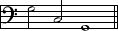
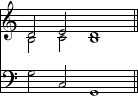
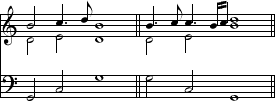
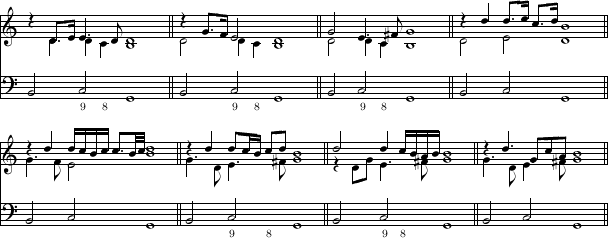
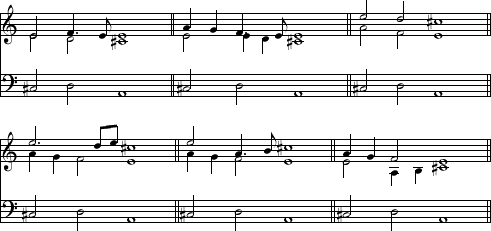
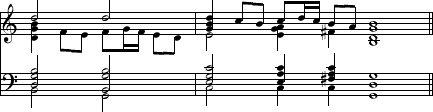
Cadentia minor simplex ungebunden
|
On the cadentia minori
Cadentia minor simplex untied
|
De la cadentia minori
Cadentia minor simplex non liée
|
|
|
|
Zierlich
|
Graceful
|
Avec grâce
|
|
|
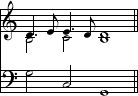
Anderst
|
Differently
|
Différemment
|
|
|
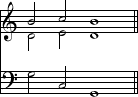
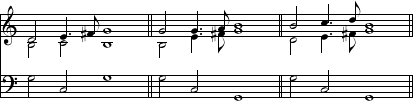
Zierlich
|
Graceful
|
Avec grâce
|
|
|
Bißweilen auch
|
Sometimes also
|
Parfois aussi
|
|
|
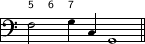
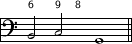
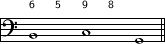
Candentia minor gebunden mit der [7] ist
|
Tied candentia minor with the [7] is
|
La candentia minor liée avec le [7] est
|
|
|
|
|
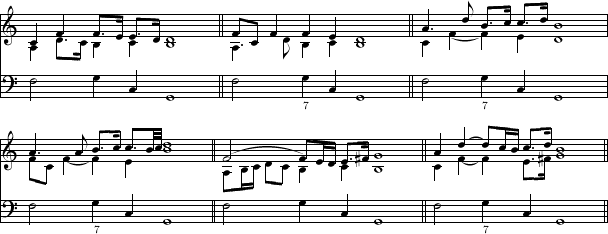
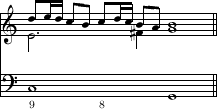
[p. 110] Gebunden mit der 9na oder 2da
|
Tied with ninth or second
|
Liée avec la neuvième ou la seconde
|
|
|
|
|
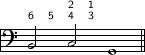
Gebunden mit der Quart, 2da oder 9na
|
Tied with the fourth, second or ninth
|
Liée avec la quarte, la seconde ou la neuvième
|
|
|
|
|
Hier conformire man sich demjenigen, was von solchen gebundenen Dissonantien
in den Regeln und allhier, die Cadenz minor auf die lezte zu beschließen,
gezeiget worden.
|
Here, one should follow what has been said about the tied dissonances in the
rules and here, to end the minor cadence on the last chord.
|
Ici, on doit suivre les règles sur les dissonances liées et,dans tous ces
cas, le dernier accord se termine par la cadence mineure. |
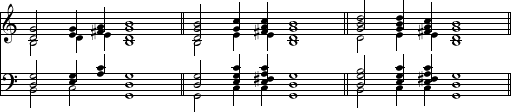
[p. 111] à 3
|
Schlecht mit 4 Stimmen und mehreren, wann die oberste Stimm also singet:
|
Bad with four voices and more, when the upper voice sings like that:
|
Mauvais à quatre voix et plus, quand la voix supérieure chante ainsi:
|
|
|
Zu notieren ist, wann die Terz minor in der vorletzten Noten ist, so soll sie
nit aufsteigen.
|
Note that if there is the minor third in the penultimate note, it should not
ascend.
|
Il est à noter que la tierce mineure ne doit pas monter quand elle se trouve
sur l'avant-dernière note.
|
|
|
|
|
Verbessert
|
Improved
|
Mieux
|
|
|
Und also auch mit mehr Stimmen zu observieren.
|
And also to observe with more voices.
|
A observer également à davantage de voix.
|
Zu End der vorletzten Noten ziehret die Cadenz sehr die bescheite Hinzusetzung
folgender durchgehender Dissonantien, nemblich 64 ,
absonderlich in den untern mit 4 und mehr Stimmen. ,
absonderlich in den untern mit 4 und mehr Stimmen.
|
At the end of the penultimate note, the cadence is much adorned by adding the
following passing dissonances, namely 64, especially in
the lower with four and more voices.
|
à la fin de l'avant-dernière note, la cadence est très ornée en
rajoutant les dissonances passantes suivantes, c'est-à-dire
6, en particulier dans les voix inférieures à
quatre voix ou plus. |
|
|
|
|
[p. 113] Terz minor
|
Minor third
|
Tierce mineure
|
|
|
Völliger
|
Fuller
|
Plus plein
|
|
|
Aufmunterung und Bezierung der langweiligen Consonanzen
|
Gingering up and adorning of the boring consonances
|
Animation et ornement des consonances ennuyeuses
|
|
|
|
|
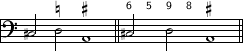
Oder, wo die Terz major ist.
|
Or, when the third is major.
|
Ou, quand la tierce est majeure.
|
|
|
|
|
[p. 114]
NB. Schließlich ist die Noten dieser Cadenz jederzeit mit der Terz major zu
nehmen, so wohl mitten als am End des Gesangs oder Stücks, sonsten wäre sie
keine rechte Cadenz.
|
NB. Finally one has to take the note of this cadence always with the major
third, in the middle as well as at the end of the song or piece, otherwise it
would not be a right cadence.
|
NB. Finalement, on doit toujours jouer les notes de cette cadence avec la
tierce majeure au milieu et à la fin du chant ou de la pièce, sinon,
ce ne serait pas une vraie cadence.
|
last modified Wed Mar 14 15:02:23 2007 by Bernhard Lang previous: cadentia-major
up: muffat-regulae
next: cadentia-minima
|