previous: examples-semisextilis
up: muffat-regulae
next: cadentia-minor
Von den Cadenzen
|
Von den Cadenzen
Die Cadenz seÿnd entweder wahr oder betrieglich;
|
On the Cadences
The cadences are either true or deceptive;
|
Des Cadences
Les cadences sont soit vraies, soit trompeuses;
|
|
der wahren Cadenzen gibt es vornemblich dreÿerleÿ, nemblich: major, minor,
minima, welche aus den Baß erkennt werden.
|
There are mainly three true cadences, namely: major, minor
and minima, which are to be recoginsed from the bass.
|
Il y a principalement trois vraies cadences qui sont: major,
minor, minima; on les reconnait d'après la basse;
|
|
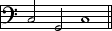
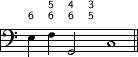
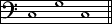
Cadentia major ist, in welcher der Baß quintweis herunter oder quartweis hinauf
springt;
|
Cadentia major is [the one] in which the bass jumps down by a fifth or
up by a fourth
|
La cadentia major est [celle] dans laquelle la basse saute d'une
quinte vers le bas ou d'une quarte vers le haut;
|
|
Cadentia minor hingegen, wo der Baß quartweis herunter oder quintweis hinauf
springt;
|
Cadentia minor on the other hand, where the bass jumps down a fourth
or up a fifth;
|
Dans la cadentia minor par contre, la basse saute d'une quarte vers le
bas ou d'une quinte vers le haut;
|
|
|
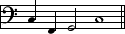
Cadentia minima, wo der Baß staffelweis ab- oder aufsteigt oder unbeweglich
bleibt.
|
Cadentia minima, where the bass ascends or descends gradually or stays
without moving.
|
Dans la cadentia minima, la basse monte ou descend conjointement ou
reste sans bouger.
|
|
|
Von der Cadentia majori
|
Von der Cadentia majori
Die Cadentia major ist entweder freÿ oder gebunden;
|
On the cadentia major
The cadentia major is either free or tied;
|
De la cadentia major
La cadentia major est soit libre soit liée;
| |
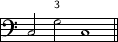
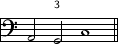
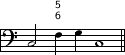
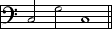
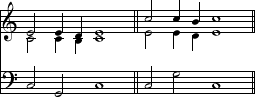
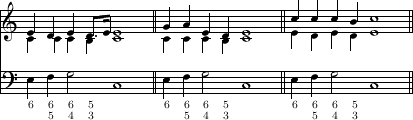
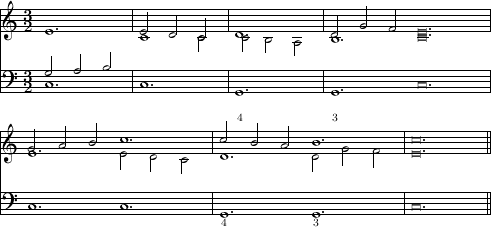
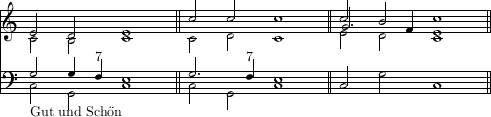
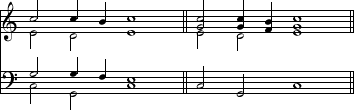
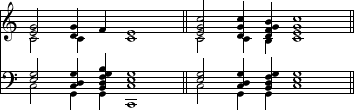
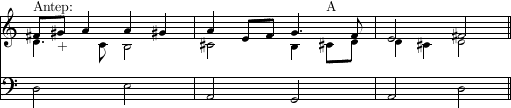
Cadentia major simplex et libera, das ist freÿ oder einschichtige Cadentia
major ist, in welcher beÿ den Oberstimmen kein Ligatur gebraucht wird.
|
Cadentia major simplex et libera, i.e. free or simple cadentia
major is where in the upper voices no tie is used.
|
La cadentia major simplex et libera, c'est-à-dire cadentia
major libre ou simple, se reconnait quand aucune ligature n'est utilisée
dans les voix supérieures.
|
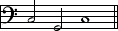
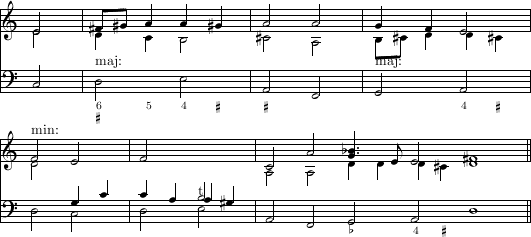
Cadentia major simplex
[p.94]
|
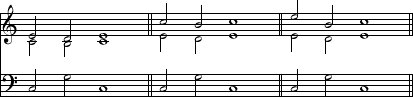
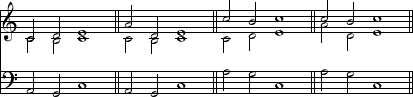
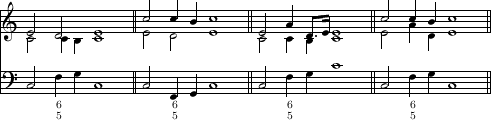
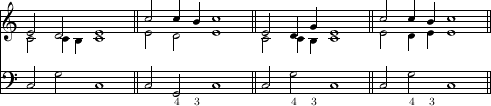
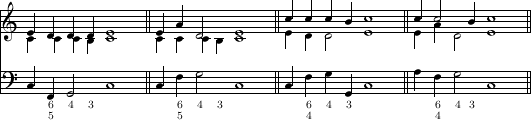
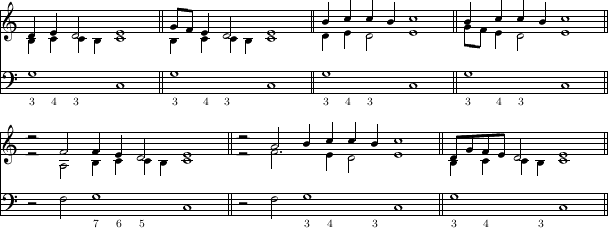
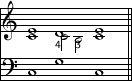
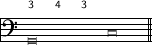
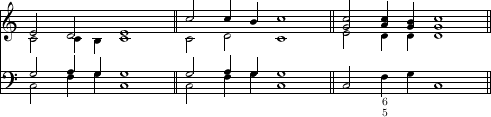
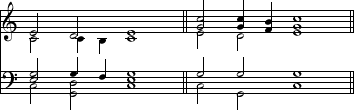
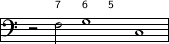
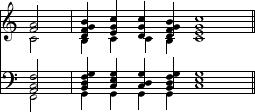
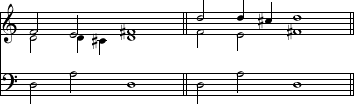
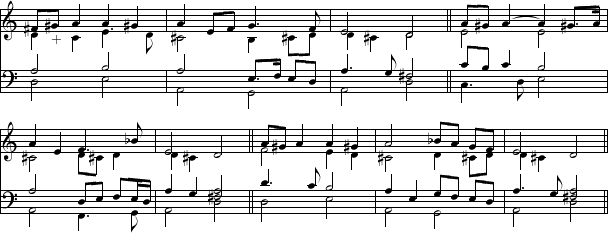
Cadentia major ligata oder gebundene, und zwar mit dem halben Sextil
|
Cadentia major ligata or tied and with the half sextil
|
Cadentia major ligata ou liée, avec le demi-sextil
|
|
|
|
|
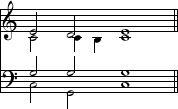
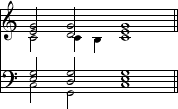
Mit der Quart wird die Quarta dissonans verstanden, wann die Quart allein
stehet
|
"Fourth" means quarta dissonans when the fourth stands lonely
|
Par"Quarte", on entend une quarta dissonans quand la quarte est
indiquée seule
|
|
|
|
|
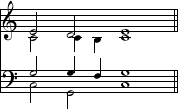
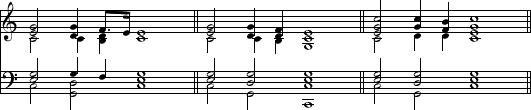
Mit Quarta consonante oder sießen Quart
|
With quarta consonante or sweet fourth
|
Avec une quarta consonante ou quarte douce
|
|
|
|
|
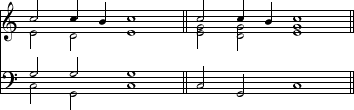
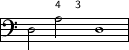
Mit den halben Sextil und Quart dissonans
|
With the half sextil and quarta dissonans
|
Avec le demi-sextil et la quarta dissonans
|
|
|
|
|
Mit den halben Theil und sießen Quart
|
With the half piece (=sextil) and sweet fourth
|
Avec la moitié (=sextil) et la quarte douce
|
|
|
|
|
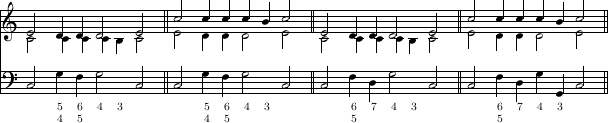
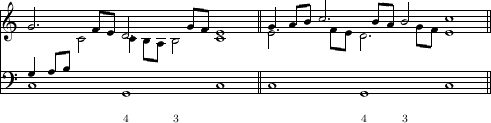
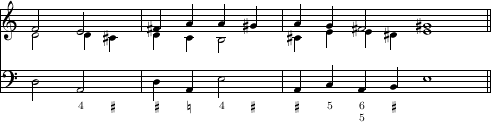
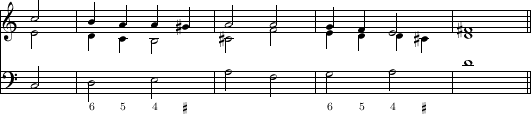
Gantze Cadenz oder Cadentia major perfectis
|
Full cadence or cadentia major perfectis
|
Cadence entière ou cadentia major perfectis
|
|
|
|
|
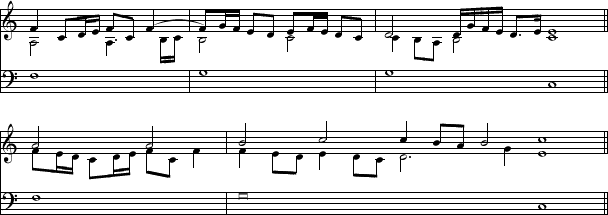
Aufgeschobene Resolvierung
|
Retarded resolution
|
Résolution retardée
|
|
|
Wann in langen Noten die Ligatur gar langsamb gehen, seÿn die Cadenz
langweilig, als
|
When the retards go very slowly in long notes, the cadence is boring, like
|
Quand les retards avancent très lentement en notes longues, la cadence
sera ennuyeuse, comme ici
|
|
|
|
|
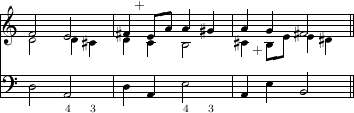
Können aber durch Vermehrung der Noten auf folgende Weis erfrischet werden:
|
Can be freshened up by increasing the [number of] notes in the following way:
|
Elle peut être raffraichie en augmentant le nombre de notes de la façon
suivante:
|
|
|
Allabreve
|
In Tripla
|
In tripla
|
En tripla
|
|
|
|
|
Also von der Cadentia perfecta
|
Like this about the candentia perfecta
|
De la cadentia perfecta
|
|
|
|
|
|
|
|
|
[p. 98]
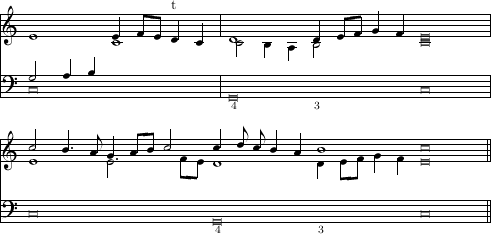
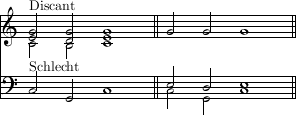
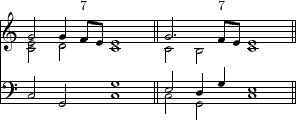
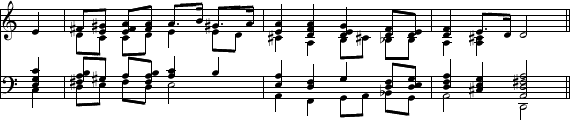
Wann man mit 4 Stimmen schlagen will, soll die oberste Stimm jederzeit fast
also gehen und singen wie eine von den zweÿen so nur mit 3 Stimm gezeigt
worden;
|
When one wants to play with four voices then the upper voice should always go
and sing almost like one of the two which have been shown with only three
voices;
|
Quand on veut jouer à quatre voix, la voix supérieure doit toujours avancer
et chanter quasiment comme l'une des deux voix déjà montrées dans l'exemple à
trois voix seulement; | |
die unter Stimm aber, als welche nur zum Anfillen taugt und nit so arios gehet
als die vorgesagte zweÿ, kann nach Aigenschafft jedes Grieffs als dann wie ein
Tenor negst am Baß unter die obgemelte zweÿ Principalen oder wie ein Alt
zwischen diesen hinzugesetzt werden.
|
but the lower voice, which is only suitable for filling and which does not go
as melodic as the two before mentioned, can according to the character of that
grip sometimes be added as a tenor near the bass below the above mentioned two
principal voices or as an alto inbetween them.
|
mais la voix inférieure qui est seulement utilisée pour remplir et qui n'est
pas très mélodique, peut être rajoutée selon le caractère des accords, des
fois comme un ténor au-dessus de la basse ou comme alto entre les deux voix
principales mentionnés ci-dessus. |
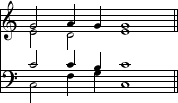
Cadentia simplex.
|
Wann aber solche schlecht singende vierte Stimm als oberste Orth an stat des
Discants nimbt, so lautet es schlecht.
|
But when such simply singing fourth voice is put at the place of the upper
voice, then it sounds bad.
|
Mais quand cette quatrième voix, qui chante simplement, est mise à la place de
la voix supérieure, cela sonnera mal.
|
|
|
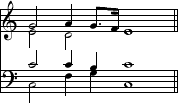
Doch lautet es besser, wann mit der Sept zu der Final in der Terz abgestiegen
wird.
|
But it sounds better when one descends by the seventh to the final third.
|
Par contre, elle sonne mieux quand on descend avec la septième sur la tierce
finale. |
|
|
[p. 99]
|
Sonst aber lautet solche Sept schier allzeit wohl in Alt oder Tenor,
|
Otherwise, such a seventh sounds always good, in the alto as well as in the
tenor.
|
Sinon, cette septième sonne toujours bien, que ce soit dans l'alto ou dans le
ténor. |
|
|
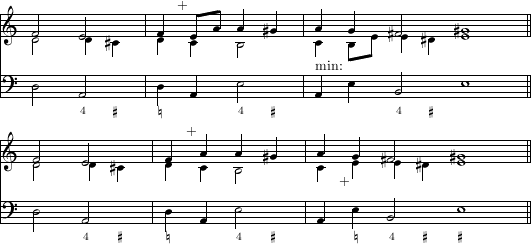
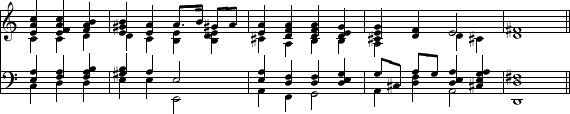
Und also auch von den gebundenen Cadentiis majoribus mit 4 Stimmen.
|
And in the same way about the tied cadentiis majoribus with four
voices.
|
Il en va de même pour les cadentiis majoribus liées à quatre voix.
|
|
|
|
|
Etwas besser
|
Somewhat better
|
Un peu mieux
|
|
|
|
|
Mit der Quart dissonante, gut
|
With the dissonant fourth, good
|
Avec la quarte dissonante, bon
|
|
|
Noch schöner
|
even better
|
encore mieux
|
|
|
|
|
Noch schöner
|
even better
|
encore mieux
|
|
|
Will man aber noch völliger schlagen, so kann man auf der Orgl duplieren jene
Consonatien, so in der Regeln zu duplieren erlaubt wird, doch soll jederzeit
eine von diesen mit 3 gezeigten Stimmen die Aria am obersten Orth an stat des
Discants führen.
|
And if one wants to play even fuller, on the organ one can double all those
consonances which the rules allow to double, but one voice, as has been shown
here with three voices, should always have the melody at the uppermost position
at the place of the treble.
|
Et si l'on veut jouer encore plus plein, on peut doubler à l'orgue tout ce qui
est permis selon les règles; mais une de ces voix, ici montré à trois voix,
doit toujours avoir la mélodie à l'endroit le plus haut, à la place du discant.
| |
Gut
|
Good
|
Bon
|
|
|
|
|
Etwas besser
|
Somewhat better
|
Un peu mieux
|
|
|
Auf den Instrument dupliert man auch zum fillen bißweilen alles, obschon wider
die Regl.
|
To fill, one doubles sometimes everything on the instrument, although against
the rule.
|
À l'instrument, on double parfois tout pour remplir, même si c'est contre la
règle. | |
In Cembalo erlaubt
|
Allowed on the harpsichord
|
Permis au clavecin
|
|
|
|
|
|
|
[p. 101] In Cadentia majori gebraucht man sich allzeit der Terz major in der
vorletzten Noten.
|
In the cadentia majori always the major third is used in the note
before last.
|
Dans la cadentia majori, l'avant-dernière note est toujours une tierce
majeure. | |
NB. Versuche in der wahren Cadentia majori.
|
NB. Tries in the true cadentia majori.
|
NB. Essais dans la vraie cadentia majori.
|
|
|
|
|
In der letzten Noten aber der Cadenz wird auch offt die Terz major gebraucht,
wann solche Cadenz einen Theil des Stücks endet, doch wann der Tonus von Terz
major ist, braucht man auch in der Mitten des Gesangs offt die Terz minor.
|
And in the last note of the cadence one uses also often the major third when
such cadence ends a part of the piece, but when the key is with major third one
often uses the minor third in the middle of the song.
|
Pour la dernière note de la cadence, on utilise aussi souvent la tierce
mineure quand cette cadence finit la piece; mais quand la tonalité
contient déjà la tierce majeure, on utilise aussi souvent la tierce mineure au
milieu du chant.
| |
Am End aber soll die Terz major genommen werden, es seÿ ein Ton wie es will.
|
But at the end the major third should be taken, whatever key it should be.
|
Mais à la fin, on doit jouer la tierce majeure, quelle que soit la tonalité.
|
|
Wann die Terz major in der letzten Noten der Cadenz genommen wird, ist folgende
Abwexlung gut, absonderlich, wo gemelte Terz major ein Diesis  hat. hat.
|
When one takes the major third in the last note of the cadence, the following
variation is good, especially where the mentioned third has a sharp .
|
Quand sur la dernière note de la cadence, on joue la tierce majeure, la
variation suivante est bonne, en particulier quand la tierce mentionnée est
dièsée .
| |
Gut
|
Good
|
Bon
|
|
|
[p. 102] Schlecht, da nach der Terz major abgestiegen wird.
|
Bad, because one descends after the major third.
|
Mauvais, parce qu'on descend après la tierce majeure.
|
|
|
Hingegen, ist die Terz minor auf der letzten Noten, ist gut nach der Terz minor
abzusteigen.
|
In contrast, when there is the minor third at the last note, it is good to
descend after the minor third.
|
Au contraire, quand la tierce mineure se trouve sur la dernière note, il est
bon de descendre après la tierce mineure.
|
|
|
Also ist die Aigenschafft der Terz major aufwerts zu gehen.
|
It is a characteristic of the major third to ascend.
|
Et alors, monter est une caractéristique de la tierce majeure.
|
|
|
Da man zweifflet, ob in der vorletzten Noten der Cadenz die Terz major oder die
minor genommen soll werden, last man sie also, wie folgt, welches à 3 so wohl
mit einer als mit der anderen lautet.
|
When one is in doubt whether one should play the major or minor third in the
penultimate note, one lets it as follows, which sounds à 3 as well with the
former as with the latter.
|
Quand on hésite à jouer la tierce majeure ou mineure sur l'avant-dernière
note, on la laisse comme ci-dessus, ce qui, à 3 voix, sonne aussi bien avec
l'une qu'avec l'autre. |
|
|
[p. 103]
Unterschiedliche Cadenzen.
|
Different Cadences.
|
Différentes Cadences.
|
|
|
|
|
|
|
Völliger
|
Fuller
|
Plus plein
|
|
|
Hingegen per tertiam minorem in d, e, g, a
|
In contrast by minor third in d, e, g, a
|
Au contraire, par tierce mineure sur re, mi, sol, la
|
|
|
|
|
[p. 104]
Mit Terz minor und major nacheinander in d, e, g, a.
|
With minor and major third subsequently in d, e, g, a.
|
Avec une tierce mineure suivie d'une tierce majeure sur re, mi, sol, la.
|
|
|
|
|
Ein anders Exempel; Terz major
|
Another exanple; major third
|
Un autre exemple; tierce majeure
|
|
|
|
|
Eben dieses aber mit der Terz minor
|
The same but with minor third
|
Le même mais avec une tierce mineure
|
|
|
|
|
Schön à 4.
|
Nice à 4.
|
Bon à 4.
|
|
|
|
|
|
|
Terz minor und major nacheinander
|
Subsequently minor and major third
|
Tierce mineure suivie d'une tierce majeure
|
|
|
|
|
à 4
|
[p. 106] Völlig
|
Full
|
Plein
|
|
|
|
[* etc. as above]
|
[* etc. comme ci-dessus]
| |
Da die Terz major aber vor der minor gehet
|
And when the major third comes befor the minor
|
Quand la tierce majeure est avant la tierce mineure
|
|
|
|
|
Anderst
|
Differently
|
Différemment
|
|
|
à 4
|
[p. 107] Anderst
|
Differently
|
Différemment
|
|
|
|
|
Dem concertierenden Singer oder Instrumentisten die Cadenz vorhin schön zu
insinuieren, hüllft sehr die Noten der künftigen Terz major, so hernach auf
die vorlezte Noten der Cadenz zum Schließen genommen wird, etwas voran in der
Antepenultima durchgehender Weis zu berühren.
|
To indicate the cadence to the concerting singer or instrumentalist, it helps a
lot to touch the note of the coming major third, which will be taken to
conclude at the penultimate note of the cadence, already in a passing way in
the antepenultima.
|
Pour indiquer la cadence au chanteur ou à l'instrumentiste concertant, cela
aide beaucoup de jouer la note de la tierce, qui va venir sur
l'avant-dernière note de la cadence pour conclure, en passant par
l'antepenultima. |
|
|
|
|
|
|
Terz minor
|
Minor third
|
Tierce mineure
|
|
|
Terz major
|
Major third
|
Tierce majeure
|
|
|
[p. 109] Auf solches Liecht, wie gegeben worden, ist leicht mit mehrern
Stimmen, wann man will, alles starck zu fillen.
|
In such light, as given here, it is easy to fill everything strongly if one
wants.
|
Dans une lumière ainsi rendue, il est facile de tout remplir de manière très
pleine avec plusieurs voix, quand on le veut.
|
last modified Wed Mar 14 15:02:22 2007 by Bernhard Lang previous: examples-semisextilis
up: muffat-regulae
next: cadentia-minor
|